
Asynchronous Writing Classes as Radical
But in the right ways?

I’ve spent every year since 1981 trying to radicalize something — a class, a body, a trip, myself. That year I made a pledge: something new, every year, no exceptions. It started as a way to override a body that had spent its adolescence in a wheelchair, warned off anything that raised its heart rate. My history told me to be fearful, but my will wanted to redefine my capabilities. Radicalizing became a passion. Not a rule-breaker by temperament — someone who broke one rule, once, out of necessity, and then couldn’t stop.
When I say I radicalized a writing workshop this summer, I want you to know the kind of person doing the radicalizing.
Self-radicalization was mental, physical and emotional. All overlapping in, not bravery, just hands-on-my-hips determination.
Nordic and alpine skiing. Backpacking. Weightlifting. Hip hop dancing. Solo travel to places where lone women don’t necessarily feel safe. Trekking dunes in southern Colorado. Snorkeling the Red Sea. Riding buses with livestock in Guatemala, trading currency in Yemen’s black market, walking the length of Skopje for no reason but ice cream. And the heart work, which scared me in different ways: teaching writers in Palestine to run their own workshops. Becoming a one-woman-show performer. Helping start an activist literary organization that mattered.
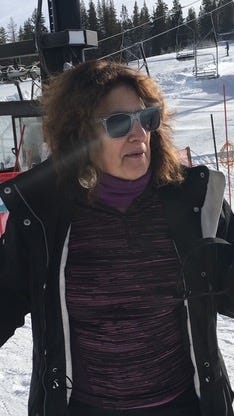
Not shabby.
I have the fails to match. Terrified rappelling a sheer wall in the Black Canyon of the Gunnison. Broke my tailbone rollerblading in Golden Gate Park. Quit a Bhangra class mid-session, out of breath, while the teacher — twenty years older than me — kept busting Bollywood moves without missing one. I don’t regret most of it. (in retrospect)
Every act, whether is physical or mental, builds a muscle.
I also am not a blind adventurer. I’m willing to quit anything the second it stops feeling like risk and starts feeling like fear. Scene: climbing the cupola at St. Peter’s Basilica, claustrophobia hitting hard, turning around, pushing back through a one-way crowd to get the fuck out before I stopped breathing.
I don’t mind failure too much, I don’t embarrass easily, and I often trick myself into confidence. Which was my modus operandi this summer, in front of a class called Creative Writing and Social Impact, my first attempt at teaching an asynchronous creative writing class.
Students working alone, at their own pace, through online materials, never meeting each other, some never even seeing my face. To complicate things, it was a Summer Session class: five weeks to build what usually takes fifteen.
This felt bigger than backpacking through the Uncompahgre Wilderness and had less footing than the trek through the Grand Canyon. The Writing Workshop, as I’ve always taught it, runs on three things: trust, community, and being seen. Writers trust that their work will be taken seriously. They find a “we’re all in this together” current that carries them through the weeks they’re misfiring and evolving. The teacher and the room see each piece, immerse in it, whatever form it takes. That’s the whole engine — interaction.
Asynchronous learning denies the premise entirely, no exchange, no room, no current.
So, the question wasn’t really “can I teach this class online.” It was: how do I fake a room that doesn’t exist?
II
I have tried new things as a teacher—taught screenplay without having written one, gave courses in business writing although my experience was solely in public relations, created new classes where I had to start from scratch.
When COVID happened and we shifted online, that called for some maneuvering to create the in-class community vibe, but I cracked the code. (MORE IN LATER SUBSTACKS)
I have friends and colleagues who have already taught asynchronous classes. They kind of shrug and say, yeah, it’s hard, but for me it was more than hard. I felt challenged to teach against my nature, and I thought at the time, counter to my beliefs.
When a creative writing class is a solitary, lone, do it as-you-go, pursuit, how do I design it so they get all the feels, good and not so, that give them the creative writing bug and buzz?
I researched all the materials I could find about successful class designs; I studied syllabuses of teachers I admire. I even, confessing here, asked Claude, how would you design an asynchronous class out of (insert semester syllabus here). I also consulted my assistant, an alum, who had asynchronous classes in other disciplines, what worked best.
I can’t possibly walk back through the process that I traveled through to materialize the class, and you wouldn’t want that, but hopefully you want a summary of my hits and misses.
Let me start with my Misses:
· I imagined with good design, I could cover the same amount of work done in an asynchronous class as in a live one. I realized however, that the accumulation of knowledge and awareness that comes from in person discussion is hard to replicate ahead of the class.
· I couldn’t assign anything without a model or two or three. Although I wanted to steer them away from imitation, and using the model as a resource for AI generated writing, I realized that a variety of styles from traditional, lyric, narrative, hybrid, experimental gave them a place to hook to.
· I started the semester without close reading. If nothing else, close reading focuses on craft elements and their relationship to content.
· I went days without connecting with them. Not many, but don’t leave them alone. Although asynchronous may mean less work for me, they need access and encouragement and connection
Hits:
· Give them a community even if it’s only 3-4 other writers. I assigned them writing teams with whom they were doing everything from reading, analyzing, workshopping and tons of group stuff. After the first week, the groups were reporting back that they interpret assignments together, they look at each other’s drafts, they rewrote together. Only one group couldn’t congeal which had a lot to do with crazy time zone difference and not being imaginative about solving that.
· Teach each thing 3 ways. For each module, I provided 1. an Elmaz video talking about craft techniques, for instance, how world building isn’t just setting. Then 2. I had a written cheat sheet on world building—do we see the world through the character’s stance, are there social references? 3. I provided examples of great world building, both lyrical and minimalist (Caro de Robertis, Ocean Vuong)
· Close Reading is a major moment of discovery- I love starting with poetry. Using language that is agile and flexible rather than only literary, I can draw connections through sounds, show the walls, borders, gates that end lines, open waterways between word clusters. I choose two poems that are completely different and expose my view of the underpinnings.
· Create assignments that are progressive —rather than character! Now Plot! Building the writing as interior relationships that scaffold, change and disrupt, gave them agility. For the world building, we created narrative maps of our journeys to school when we were seven years old. They stopped at each landmark and told the story—the knife sharpener outside the shoe store who also swept the temple at night. The neighbor who was calling their dog inside when it barked. For the next progression, they returned to the map and to the landmarks and created a political or social significance to it (all in storytelling voice) Paisley Rekdal’s West was particularly helpful here as they illuminated the story of the Intercontinental railroad building and its fatal impact on the builder from poem, narrative, visuals and maps.
· Let them Not write Even in a short class like summer session 1, the writing without class interaction is a grind, and sometimes feels routine. In a workshop the writers get a break when it’s “not their turn”. Mini films, panels on a teach back moment, their own PowerPoints on craft, collaging (a big fav) all feed the writing process and also clarify it.
· Try to meet with each writer once at least. Writers want to be read, heard and seen. This group were not writers-most were taking the class to fulfill a requirement. BUT 3 of them ended up sending their work out for publication. I talked to them personally; I found pieces that could rock a zine. Even if the writer is just there for the stamp, the moment of being heard is positive for them.
· Keep your eye on the outcome— this was the hardest part. Assignments flowed in because we had reader responses, exercises, and workshopping. When I first read the reader’s responses, I gave feedback and they often returned to the portal for more. But as time passed, and work piled up, I slacked, and so did they—Some AI crept in there, and I had to shuffle my assignments to make sure I was providing opportunity for some free thinking. I added elements to reader responses -- how they considered their own writing, their own story.
In the end, their final projects which were narrative maps (video or power points) of their creative writing journey show movement, progress and for some a promise to come back to creative writing
I survived the new venture of “teaching” an asynchronous creative writing class, a risk that I couldn’t imagine working. I still don’t think it delivered what an in person creative writing (or even an online one) could. Our writing is an act of assertion of the self, and the satisfaction, inspiration and motivation rise from a simple gesture of feeling the writing in the world.

Elmaz, I love this. I have taught asynchronous creative writing for many years and have been finding it more and more challenging; but you really brought new life and beautiful new ideas to the platform. Brava you! You're amazing.
What a challenge! I regularly take asynchronous classes—but in textile arts, which dovetail well with one way instruction. Creative writing is another; hard to do without community and encouragement and as you say, being seen. But this is why you are such a model for me as a teacher. I learned so much from this (every year I try to become a better teacher, so thank you).